

With more reliance on digital technology in organizations, cyber threats are not a hypothetical situation anymore; cyber threats are now becoming a reality that can cause a lot of trouble to companies regardless of their size.
Although many organizations try to protect themselves by investing in cybersecurity solutions and strategies, prevention alone will not be effective anymore. In today’s world, it is necessary for organizations to survive cyber incidents, bounce back quickly and keep functioning without any hindrance. Here, it plays an important role.
In this article, we will discuss about cyber resilience in detail including its definition, significance, difference with cybersecurity, and ways to implement it in organizations.
What Is Cyber Resilience?
It refers to the capability of an organization to prepare for, react to, recover from, and learn from cyber events while still keeping its business processes functional.
Instead of making an assumption that all cyber threats could always be thwarted, cyber resilience takes into account the possibility that some cyber threats may succeed. In this case, the main thing is to keep the negative impact to a minimum.
To put it in simple words, cyber resilience allows your business to keep functioning in spite of any cyber threats or IT disruptions.
Cyber Resilience vs. Cybersecurity
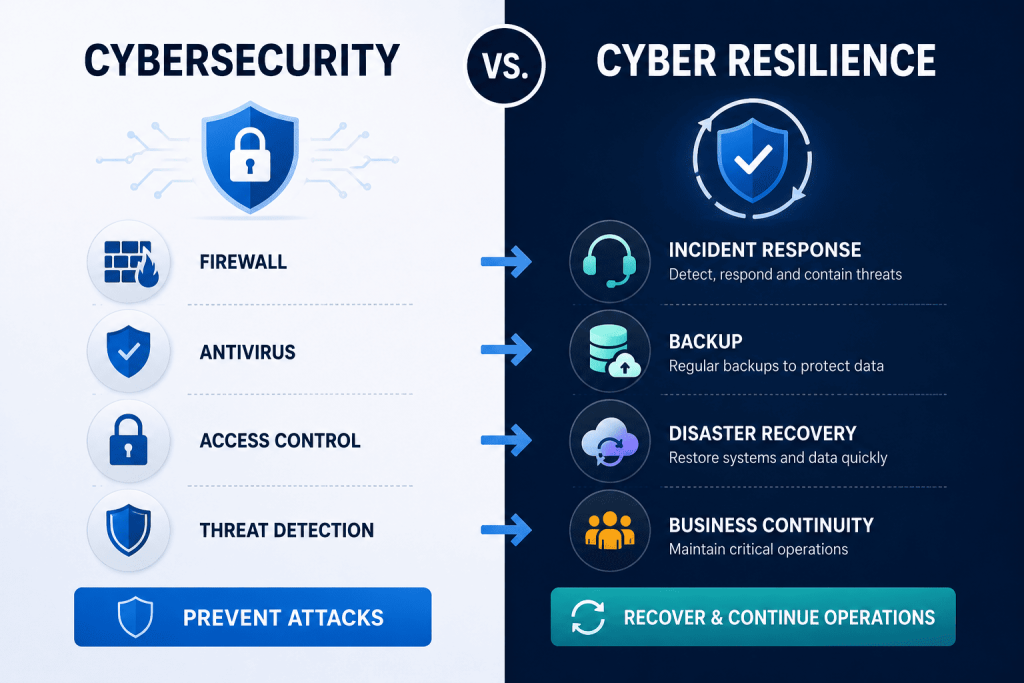
Although the terms are often used interchangeably, cyber resilience and cybersecurity have different objectives.
Cybersecurity focuses on preventing cyber threats through measures such as:
- Firewalls
- Antivirus software
- Multi-factor authentication (MFA)
- Encryption
- Access controls
- Security monitoring
Cyber resilience goes a step further by combining cybersecurity with business continuity planning, disaster recovery, incident response, and continuous improvement.
| Cybersecurity | Cyber Resilience |
|---|---|
| Prevents attacks | Prepares for and recovers from attacks |
| Protects systems | Protects business operations |
| Focuses on defense | Focuses on defense, response, and recovery |
| Reduces risk | Reduces business disruption |
Think of cybersecurity as locking the doors to your office, while cyber resilience ensures your business can continue operating even if someone breaks in.
Why Cyber Resilience Matters More Than Ever
In today’s world, modern organizations depend heavily on cloud technology, remote working arrangements, digital collaboration technology, and smart devices. With technological advancements, there come cyber risks too.
A successful cyberattack can lead to:
- Financial losses
- Operational downtime
- Loss of customer trust
- Regulatory penalties
- Damage to brand reputation
- Data theft
With no cyber resilience strategy in place, recovery after these attacks can be very expensive and time-consuming.
Companies focusing on cyber resilience have an easier time dealing with disruptions and maintaining their customer trust in difficult times.
Common Cyber Threats Businesses Face
Understanding today’s threat landscape is the first step toward building resilience.
Ransomware Attacks
Hackers encrypt company data and demand payment to restore access. These attacks can bring business operations to a standstill.
Phishing Scams
Cyber criminals use deception by sending fake emails and gaining access to confidential information.
Data Breaches
Unauthorized access to data pertaining to customers or businesses may lead to both fines and reputational harm.
Insider Threats
Employees or contractors can pose risks to confidentiality and security of sensitive information, whether deliberately or otherwise.
Supply Chain Attacks
Attackers aim at third party vendors or software providers in order to attack many firms at once.
Key Components of Cyber Resilience
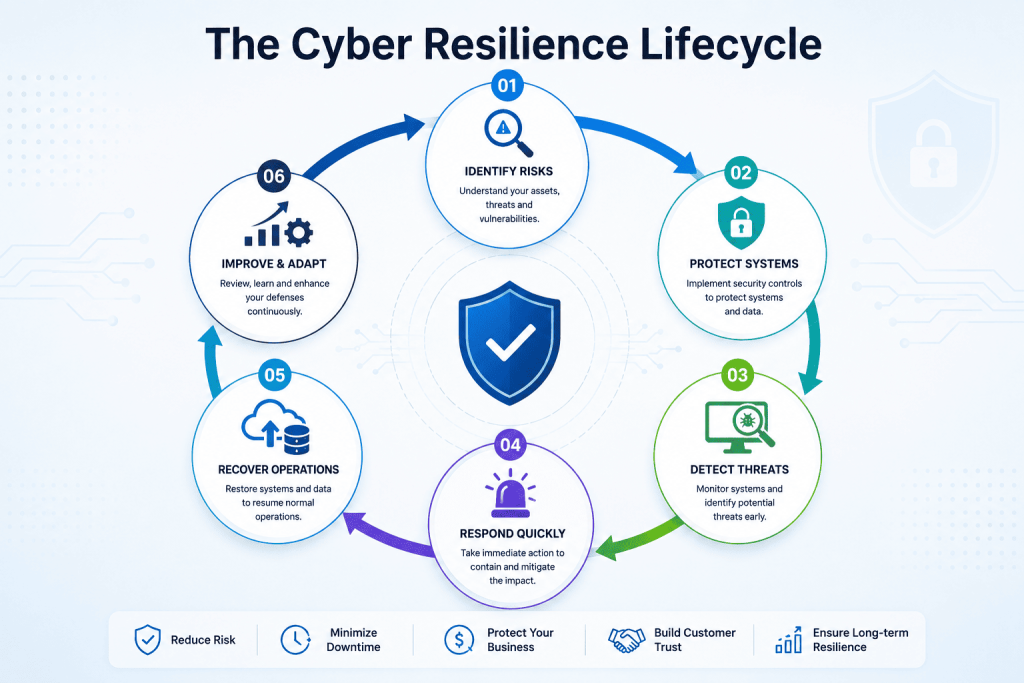
Resilience in cyberspace is achieved through technology, human resources, and procedures.
1. Risk Assessment
Discover your organization’s assets that have the highest value and assess any weaknesses that may be targeted by hackers.
2. Strong Cybersecurity Measures
Implement security best practices such as:
- Multi-factor authentication
- Endpoint protection
- Network security
- Encryption
- Regular software updates
These measures reduce the likelihood of successful attacks.
3. Data Backup and Recovery
Have backups that are secure, automatic, and tested regularly.
If you suffer ransomware attacks, your business will restore its system without having to pay the attacker.
4. Incident Response Planning
Create a documented incident response plan that outlines:
- Who responds
- Communication procedures
- Containment steps
- Recovery process
- Post-incident review
A clear plan minimizes confusion during emergencies.
5. Business Continuity Planning
Ensure critical operations can continue even when systems are unavailable.
This may include:
- Cloud-based infrastructure
- Remote work capabilities
- Backup communication channels
- Disaster recovery sites
6. Employee Awareness Training
Human mistakes continue to be among the top reasons for security breaches.
Awareness programs on cyber security can teach staff to identify phishing attacks, create good passwords, and report any suspicious behavior.
7. Continuous Monitoring
Cyber resilience is not an activity carried out once and forgotten about.
Continuously monitor your systems to notice anything out of place and deal with any security threats.
Benefits of Cyber Resilience
Organizations that invest in cyber resilience enjoy several long-term advantages.
Reduced Downtime
Quick recovery helps minimize operational disruptions.
Better Customer Trust
Customers are more likely to trust businesses that protect their information and respond effectively during incidents.
Lower Financial Losses
Early detection and efficient recovery reduce the costs associated with cyberattacks.
Regulatory Compliance
Many industries require businesses to demonstrate strong security and recovery capabilities.
Improved Business Continuity
Even during cyber incidents, resilient organizations can continue delivering products and services.
Best Practices for Building Cyber Resilience
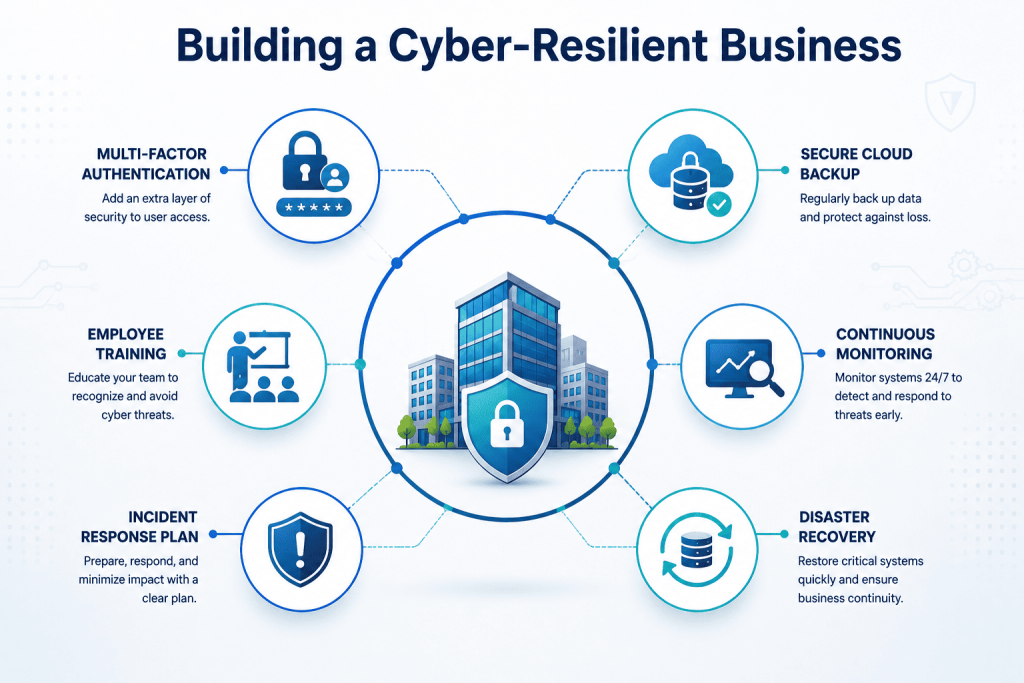
Developing cyber resilience doesn’t have to happen overnight. Start with these practical steps:
- Conduct regular security assessments.
- Keep software and operating systems updated.
- Use strong authentication methods.
- Back up critical business data frequently.
- Test disaster recovery plans regularly.
- Train employees on cybersecurity best practices.
- Monitor networks for suspicious activity.
- Review and improve your incident response strategy after every security event.
Small, consistent improvements can significantly strengthen your organization’s resilience over time.
The Future of Cyber Resilience
As businesses continue adopting cloud computing, artificial intelligence, and connected technologies, cyber resilience will become an essential part of digital transformation.
Organizations are increasingly shifting from asking:
“How can we prevent every cyberattack?”
to
“How can we continue operating when an attack happens?”
This mindset enables businesses to recover faster, reduce long-term risks, and build greater confidence among customers, partners, and stakeholders.
Conclusion
Cybersecurity threats are inevitable in the current world, but it does not mean they have to affect your business negatively.
Resilience against cyber risks is different from cybersecurity because while cybersecurity is mostly concerned with preventing threats, cyber resilience encompasses preparing for, responding to, recovering from, and learning from cyber events. A combination of security and recovery planning as well as continuous improvement enables businesses to continue their operations despite facing cyber risks.
Making cyber resilience a priority in your business means making a wise decision since you are not only securing your business but its future and that of your customers.