

The reason most startup businesses fail is not due to lack of good ideas but because they have spent too much time building the wrong product.
In any startup business, speed and validation outweigh perfection. This is why successful entrepreneurs have a solid MVP (Minimum Viable Product) development strategy.
A well-developed MVP strategy will enable you to:
- Get off the ground fast
- Validate market demand
- Lower capital investment risk
- Collect user feedback
- Enhance product market-fit
- Scale up effectively
Learn how to develop a sound MVP strategy from scratch.
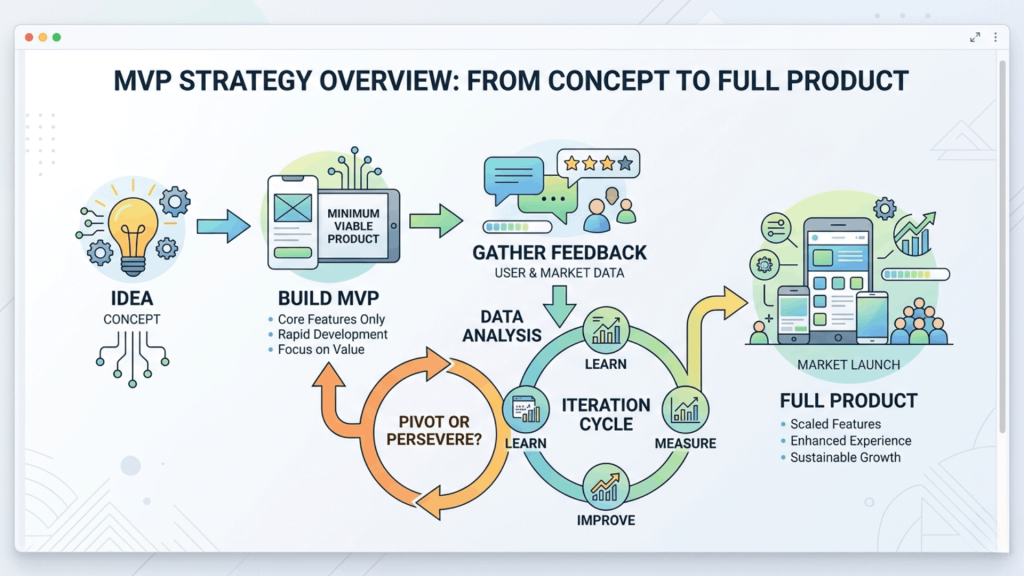
What Is an MVP (Minimum Viable Product)?
MVP is the most basic form of the product that addresses the fundamental issues faced by the targeted audience.
An MVP is not an unfinished product.
This approach is not about leaving work incomplete.
Instead, it focuses only on the essential features needed to solve the core problem.
Simplicity and purpose guide the development process.
This approach helps to:
- Check assumptions
- Test the demand for the product in the market
- Gather insights from the actual users
- Cut down on excessive development time
MVP should be seen as an experiment rather than a complete product.
Why MVP Strategy Is Important for Startups
1. Lowers risk
Development of a full-fledged product without proper testing can take several months.
2. Saves Time and Resources
Startups normally have limited:
- Budget
- Number of employees
- Development capacity
Using the MVP technique, you will know what matters.
3. Allows Early Market Entry
The earlier your startup enters the market, the earlier you will be able to learn how people behave there.
4. Helps to Achieve Product-Market Fit
The product-market fit occurs when your product is solving a problem for real users.
Using MVP, you can iteratively improve it depending on the data.
5. Attracts Investors
Investors like:
- Working prototype
- Traction
- User metrics
That’s the power of MVP.
Core Principles of an Effective MVP Strategy
1. Problem Statement
Prior to development, determine:
- Who is the target market?
- What issue do they have?
- How are they currently addressing the problem?
- How is your solution superior?
Failure to do so means failure of MVP.
2. Value Proposition
It’s vital for MVP to be able to provide an obvious answer to questions including:
- What is its unique selling proposition?
- Why would users use it?
- Why does it matter?
Value proposition ensures focus on the correct direction during development.
3. Feature Prioritization
Frameworks for prioritization include:
- MoSCoW technique (Must, Should, Could, Won’t)
- Impact versus Effort Matrix
- Mapping the Core Problem
Feature selection should be limited only to the elements solving the core issue.
Too many features means disaster.
4. Plan the User Flow before Coding
Even simple applications require a well-defined user flow.
Map:
- Entry point
- Key action
- Expected result
The better the UX, the more accurate your validation will be.
5. Pick a Technology Stack that Will Scale
While the MVP should be lean, it needs to have room for growth.
Consider:
- Front end: React/Next.js
- Back end: Node.js/Python
- Database: PostgreSQL/MongoDB
- Hosting: AWS/Azure/GCP
Don’t over-engineer, but make sure you can scale.
6. Develop the Product in Iterations (Agile Methodology)
Use short sprints for development:
- Plan
- Build
- Test
- Deploy
- Refine
Feedback is always better than prolonged development periods.
7. Release Early, Even if It Is Far from Perfect
Perfection is the enemy of progress.
An MVP doesn’t require:
- Sophistication
- Complex animation
- Automation
- Integration
An MVP requires:
- Reliability
- Ease of use
- Key functionalities
Validation Strategies After Launch
Creating an MVP is just half the battle plan; validation comes after.
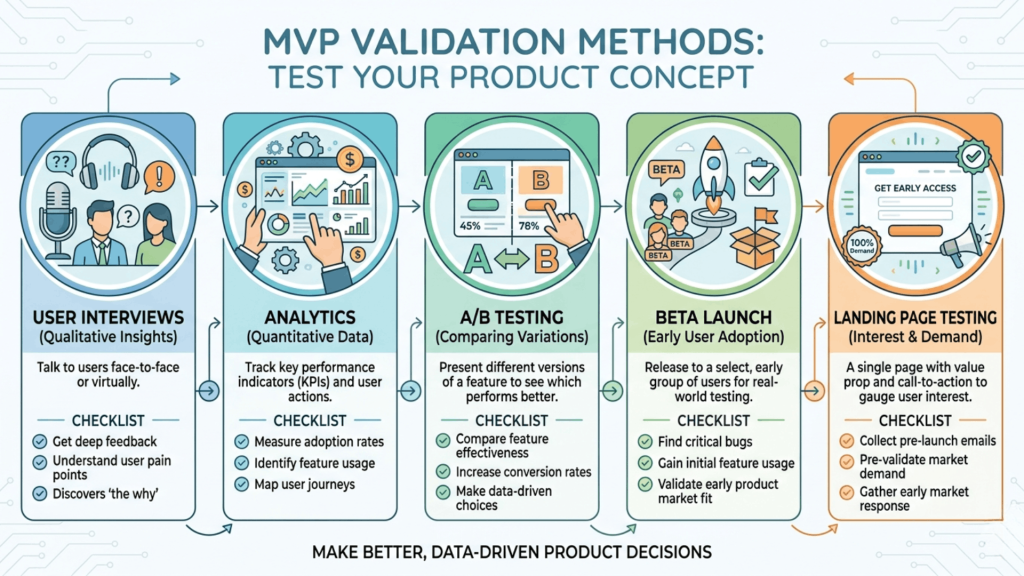
Popular Ways to Validate:
1. Interview Users
Gain firsthand knowledge from early users.
2. Data Analytics
Track:
- User interactions
- Session length
- Where users drop off
3. A/B Testing
Test different iterations for effectiveness.
4. Beta Testing
Launch to select users.
5. Landing Pages
See how much interest there is before building anything.
Measures that Measure MVP Success
These include but are not limited to:
- Customer acquisition rate
- Customer activation rate
- Customer retention rate
- Customer engagement
- Customer feedback quality
- Customer conversion rate
Data helps improve the product.
MVP Fails to Look Out For
- Too Many Features
More features = More confusion
- Not Listening to Feedback
The MVP’s purpose is learning!
- Trying To Reach Everybody
Focusing on one audience is better.
- Trying To Reach Everybody
Focusing on one audience is better.
- Waiting Too Long
There is no perfect time to launch.
- Adding Unnecessary Features to Your Architecture
Overcomplicating things too early is bad.
Cost Factors for MVP Development
The cost will vary based on:
- Complexity
- Design needs
- Integration issues
- Development team
- Timeframe
But our aim is not merely to find the most economical solution; we seek the wisest investment.
A properly planned MVP saves money in future development by avoiding false premises.
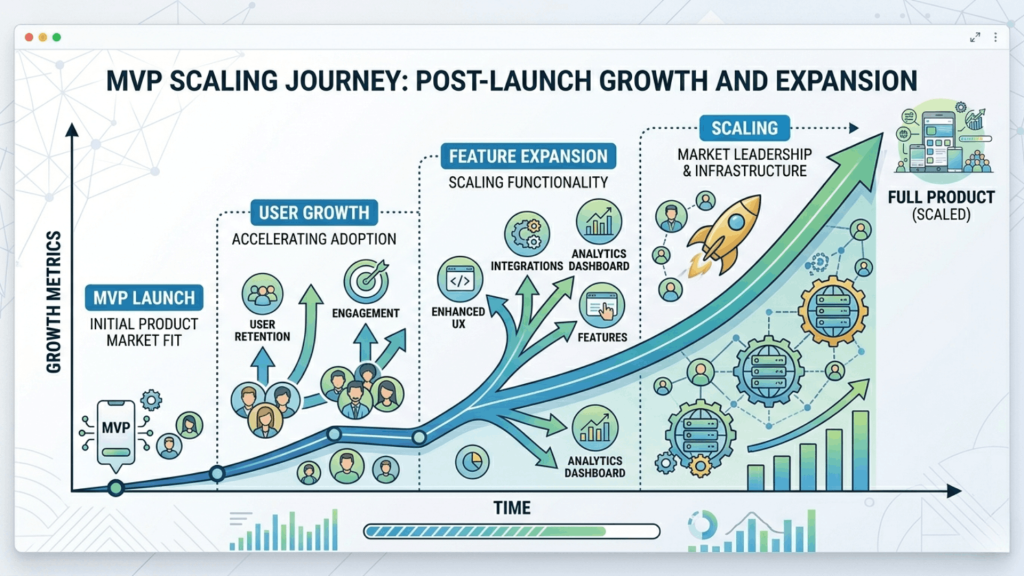
Signs to Move from MVP to Full Product
It’s time to shift gears once:
- Users start using the product
- Demand is confirmed
- Feedback is consistent
- Growth signals are positive
- Revenue model works
Now, you can:
- Include sophisticated features
- Enhance scalability
- Improve performance
- Broaden market coverage
MVP Validation Scaling Strategy
Once validated:
- Strengthen architecture
- Increase security
- Improve UI/UX
- Boost performance
- Add features
- Introduce automation
- Scale for users
Scaling should be done gradually and based on data.
Startup Thinking Underpinning MVP Development
In successful startups:
- Learning comes before guessing
- Speed beats perfection
- Feedback trumps assumptions
- Validation precedes speculation
- Growth precedes complexity
MVP development is just the beginning.
Conclusion
A well-thought-out MVP development process will help startups:
- Mitigate risks
- Conserve resources
- Verify concepts
- Fast-track launches
- Enhance product-market fit
- Create scalable frameworks
The core idea remains straightforward:
Build the minimum required to learn the maximum possible.
Begin small. Launch quickly. Innovate constantly.
This is how successful digital products get made.