

In the contemporary world, which is software-oriented, businesses have started investing heavily in applications, clouds, APIs, and connected technologies. However, while innovations continue to grow, cyber threats are becoming more sophisticated, more common, and more costly than ever before.
For decades, cybersecurity had been perceived by most organizations as an afterthought, a mere check-list requirement before the launch of a product or service. This practice is no longer relevant, as modern cyber threats are much more sophisticated, occur more often, and are much costlier than ever before. In addition, any vulnerabilities in software can lead to exposure of sensitive information, disruption of the business process, damage to reputation, and losses.
Thus, nowadays cybersecurity should become a part of the software development life cycle, as it cannot be ignored anymore.
The Growing Cybersecurity Threat Landscape

Cyber criminals are always finding ways to attack companies of any size. Whether through ransomware attacks, phishing, API vulnerabilities, or cloud attacks, companies are under threat from different angles.
Applications today are also much more sophisticated compared to traditional software programs. They use:
- Third-party components
- Cloud computing
- Open-source frameworks
- APIs and microservices
- Collaboration solutions
- Mobile and web platforms
Even though these innovations have added value to software applications, they have also created many possible vectors through which cybercriminals can attack.
Organizations that do not consider security during their application development usually find out about their vulnerability during implementation.
Why Security Can’t Be Added Later
However, many software development teams continue to adhere to obsolete workflows that include security testing towards the end of the project. It leads to numerous problems:
1. Security Vulnerabilities Are Harder to Eliminate
When security vulnerabilities are identified late during the development process, developers may have to redesign or rewrite certain application components entirely, which will cause project delays and extra expenses.
It is much easier to create a secure software architecture right from the start than try to fix vulnerabilities after everything has been implemented.
2. Data Breach Risks Business Reputation
Businesses are supposed to ensure the safety of their customers’ personal and financial information. Even the smallest security violation can undermine customers’ trust to a product or a company.
3. Compliance Is Getting Stricter
The requirements to data privacy and cybersecurity become stricter every year as different industries introduce new regulations. Companies are now required to meet such standards as:
- GDPR
- HIPAA
- PCI DSS
- ISO security frameworks
Failure to implement any of these standards can lead to legal penalties and even compliance violations.
4. The Cost of Attacks Is Higher Than That of Preventing Them
The financial toll of a cyberattack is usually much higher than that of putting up preventive measures. Firms may incur costs associated with:
- Downtime
- Revenue loss
- Legal expenses
- Costs of recovery
- Reputational loss
- Churn rate
Preventive cybersecurity has become one of the most cost-efficient business ventures.
The Shift Toward Secure Software Development
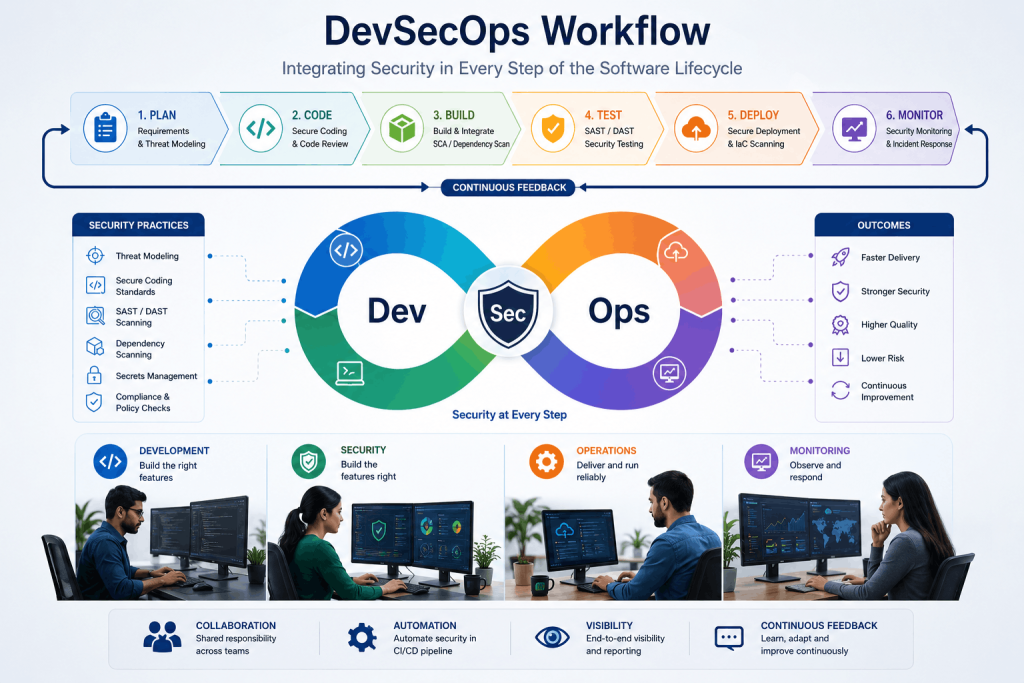
Today, software developers are increasingly using the concept of “security first.” This strategy is referred to as Dev SecOps, which involves incorporating security within the development process.
DevSecOps is a way to incorporate cybersecurity responsibilities into the activities of multiple teams rather than keeping cybersecurity as an independent team or department.
Cybersecurity must be considered at the following stages:
- Planning
- Architecture
- Coding
- Testing
- Deployment
- Maintenance
- Scaling
It is always better to catch any vulnerability early.
Important Cybersecurity Principles for Modern Development
Secure Coding Principles
It is important for developers to adhere to secure coding principles in order to avoid the following vulnerabilities:
- SQL injections
- Cross-site scripting (XSS)
- Broken authentication
- Insecure API
- Buffer overflow
Secure coding reduces vulnerabilities before software even enters the production environment.
Security Testing
Security testing is carried out continuously in order to detect any vulnerabilities that may be present in software before any malicious entity does. Some of the security testing techniques include:
- Penetration testing
- Vulnerability scanning
- Static application security testing
- Dynamic application security testing
- API security testing
Security of APIs
Current applications rely heavily on APIs for interaction among various systems and services. Unsecured APIs represent one of the most popular vulnerabilities to exploit nowadays.
Companies need to use:
- Authentication mechanisms
- Rate limiting
- Data encryption
- Access controls
- Monitoring of APIs
It is crucial to protect APIs since they may include sensitive information and are prone to attacks.
Cloud Security
The shift towards cloud technologies makes cloud security a primary concern.
Cloud computing involves:
- Configuration security
- Access and identity management
- Data encryption
- Backup plans
- Monitoring
The incorrect configuration of cloud services represents one of the major reasons for data leakage.
Awareness and Training of Employees
Human mistakes are some of the biggest cybersecurity threats. Even the best software can become compromised if employees get fooled by phishing schemes or choose poor password strategies.
Companies should train their employees in:
- Password best practices
- Social engineering dangers
- Data protection measures
- Multi-factor authentication
- Remote work safety
Cybersecurity involves both technology and humans.
AI in Cybersecurity
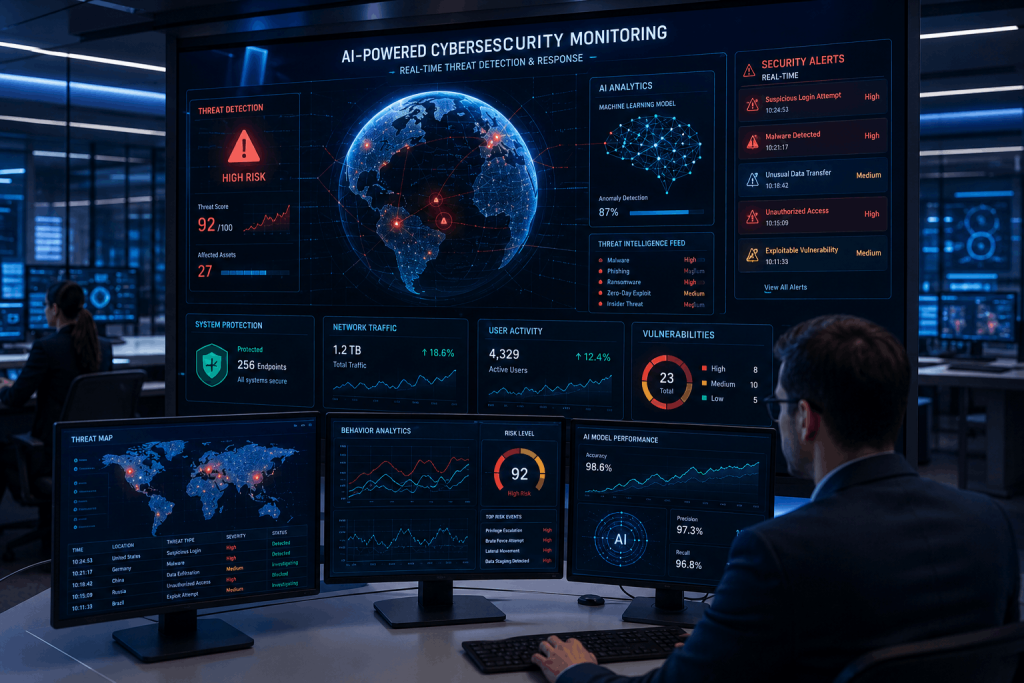
AI is revolutionizing both cybersecurity defenses and cyberattacks.
Cybersecurity experts now use AI-enabled solutions for:
- Identifying anomalies
- Faster threat detection
- System monitoring
- Incident automation
- Vulnerability analysis
On the other hand, hackers are leveraging AI to develop more sophisticated phishing schemes and automated attacks.
This AI arms race calls for proactive security measures among software developers.
Cybersecurity as a Competitive Edge
Businesses now base their choice of technology partners on their security capabilities. There are many benefits to choosing cybersecurity first:
- Increased client confidence
- Greater compliance readiness
- Lower operational risk
- Enhanced reputation
- Quick incident management
- Cost savings in the long run
Security is not just an IT requirement anymore; it is part of the business model itself.
Early investment in cybersecurity prepares businesses for their future growth and development.
The Future of Software Development Is Security-First
With cyber attacks becoming more advanced, software security can no longer be considered an optional aspect. Organizations delaying the implementation of cybersecurity put their operations at risk and may suffer significant consequences.
In modern software development, it is essential to have a proactive stance on security by including cybersecurity at every phase of development. Starting from secure code writing, API protection, cloud security, and ongoing testing, organizations should focus on safeguarding their processes.
In the future, the success of software firms will not only depend on what they develop but how secure they are.