
Introduction
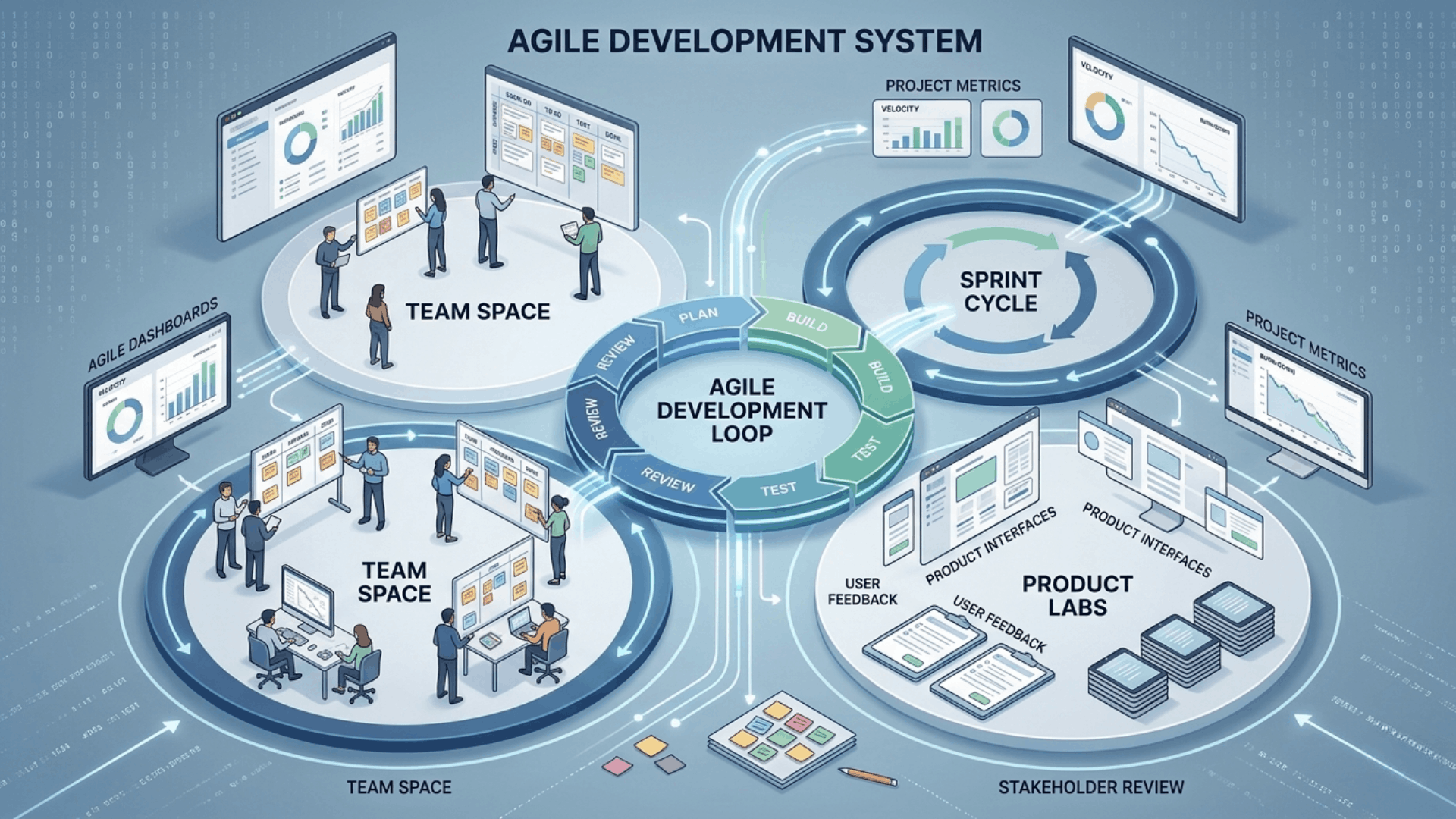
There is an unsung void in the software industry.
On one hand, almost all organizations claim to practice agile software development. On the other, many have difficulties dealing with late releases, disconnected teams, and applications that don’t connect with their users.
But what’s going wrong here?
The problem doesn’t lie within agile, but rather in its interpretation.
Many define agile as:
- Daily standups
- Sprint planning sessions
- Retrospectives
Yet this is merely scratching the surface.
Underneath this approach lies much more profound methodology:
a process that continually eliminates uncertainty and adds value at the same time.
In this blog, you will find out more about this approach.
Agile Begins Where Certainty Ends
Each software development project begins with a number of assumptions:
- The needs of the customers
- Their behavior
- Which issues they care about most
- Which features will add value
Conventional software development attempts to prove each of these points before anything else.
Agile software development makes an entirely opposite assumption:
that you’re wrong, and devises a system to fix this problem promptly.
Instead of months spent in planning, agile software developers:
- Start small
- Test early
- Learn constantly
- Change immediately
Agility is not an end in itself.
It is a way of preventing expensive mistakes.
The Real Architecture of Agile: Systems Thinking
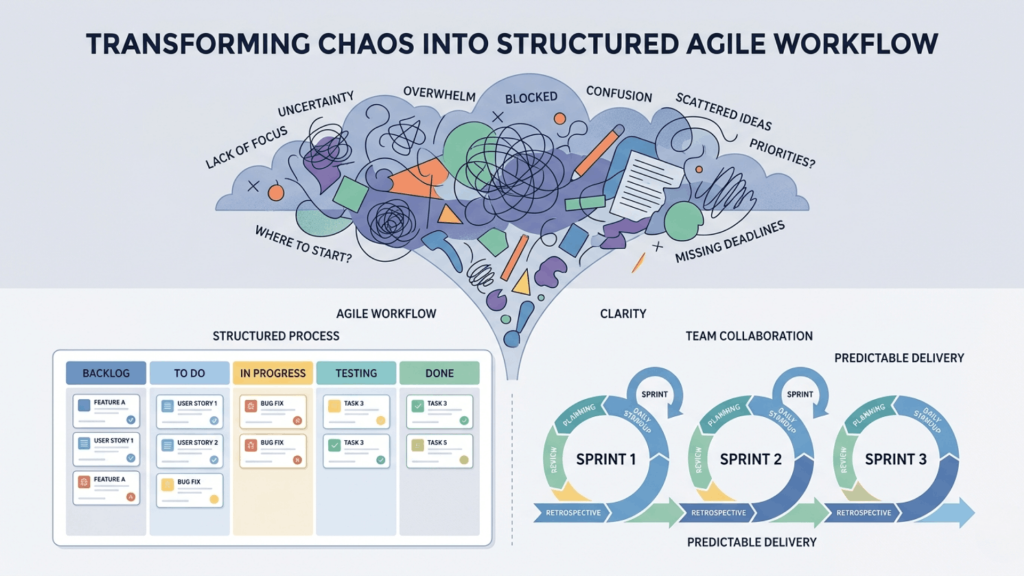
To comprehend agile software development appropriately, one has to consider systems thinking and not task thinking.
Agile operates in three interdependent layers:
1. Learning System
Each sprint is a cycle of learning:
- What went well?
- What did not go well?
- What needs to be changed in the future?
Thus, agile software development becomes an endless feedback process.
2. Delivery System
The practice of agile guarantees regular delivery of working software rather than planning alone.
Regular delivery:
- Lowers risk
- Increases transparency
- Develops stakeholder trust
3. Alignment System
Agile helps teams stay in line with organizational objectives by means of:
- Backlog management
- Prioritizing
- Involving stakeholders
Without alignment, even very efficient teams work on the wrong project.
These systems collectively bring about controlled flexibility, agile’s unique power.
Feedback Loops: The Core Engine of Agile
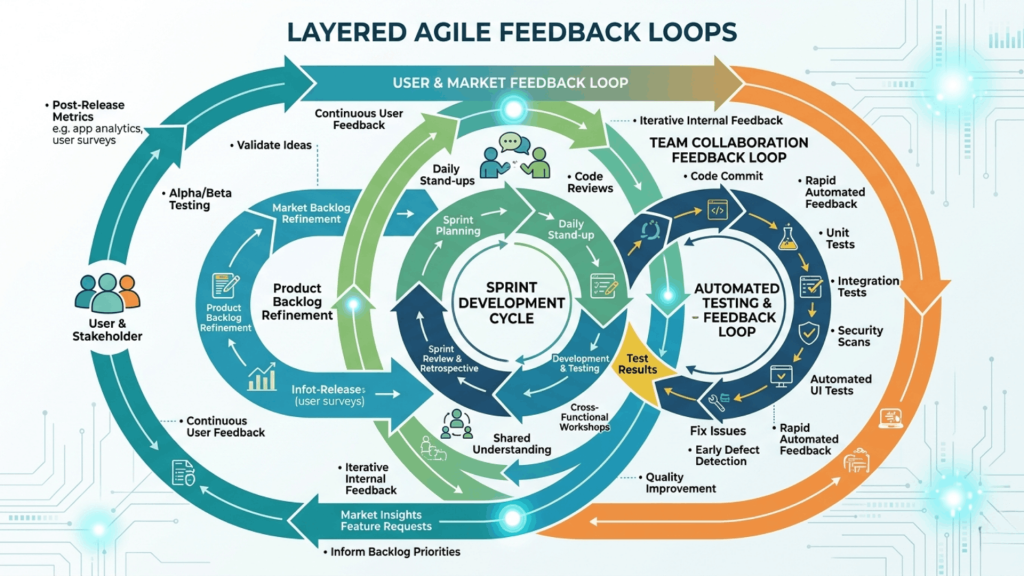
At the heart of agile software development are feedback loops.
A short loop guarantees success.
Feedback Loop Types
1. User Feedback Loop
Users use the product in its earliest forms.
They identify:
- Ease of use
- Relevance of features
- Behavioral characteristics
2. Technical Feedback Loop
Testing tools, CI/CD pipeline, and monitoring systems offer immediate information on:
- Defects
- Performance problems
- Integration issues
3. Team Feedback Loop
Collaboration every day ensures:
- Quick decision making
- Less confusion
- Continual improvement
Agile developers don’t look for feedback; they build their systems to collect it all the time.
Why Agile Fails in Many Organizations
If agile works so well, then why do so many organizations fail at it?
It’s because they embrace the process, without embracing the philosophy.
1. Ceremony Without Context
Teams participate in agile ceremonies without knowing why.
Daily stand-ups turn into daily status updates instead.
2. Feature Factories
Teams focus more on output than outcome.
Teams develop features, but never evaluate their results.
3. Resistance to Change
Ironically, some teams see agile methodologies as inflexible.
But agility and adaptability are the foundation of agile.
4. Absence of Product Vision
Without a strategic vision, even agile will get you nowhere.
Agile doesn’t solve strategy, it multiplies it.
Agile vs Traditional Development: Beyond the Surface
The difference is not merely about workflow but philosophy.
Traditional Approach
- Plan-build-test-release linear approach
- Heavy reliance on documentation
- Lack of flexibility
- Feedback obtained after completion
Agile Approach
- Iterative process
- Continuous deployment
- Flexibility built into the process
- Feedback received continuously
However, there is a more profound change:
The traditional approach favors predictability.
The agile software development approach favors adaptability.
Adaptability always beats predictability in a dynamic environment.
The Role of Collaboration: Breaking Down Silos
One of the most revolutionary changes brought about by agile software development is the change that happens within the dynamic of the teams involved.
In a non-agile environment:
- Designers Design
- Developers Develop
- Testers Test
In an agile environment:
- Teams are multi-skilled
- Collaboration happens throughout
- There is no single point of responsibility
What comes out is:
- Effective problem solving
- Effective decision making
- Greater accountability
Agile and Product Thinking: Building for Impact
Agile in the absence of product management is flawed.
In order to be successful, teams need to pay attention to:
- User benefits
- Business benefits
- Real results
Which translates to:
- Making decisions around feature prioritization based on ROI
- Validating hypotheses before scaling them
- Dying bad features
Agile development becomes potent by constantly asking itself:
“Are we building something that really matters?”
Scaling Agile: From Teams to Organizations
Agile functions very well in smaller groups.
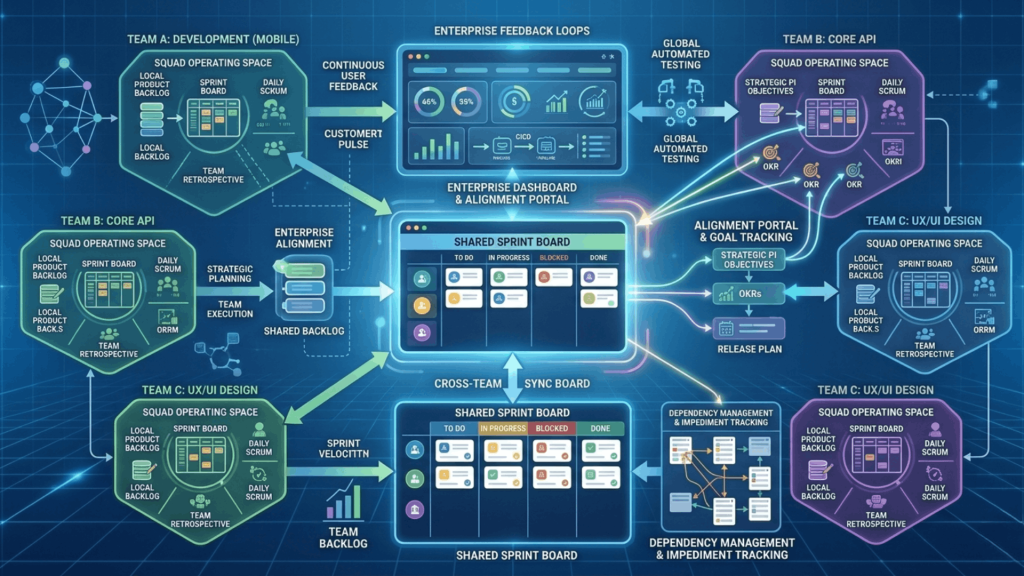
The problems arise when you want to scale Agile to the entire organization.
Some of the problems are:
- Communication among teams
- Dependence of tasks among teams
- Consistency issues
Effective scaling will need:
- Effective channels of communication
- Common objectives/goals among teams
- Decision-making autonomy
Measuring Success in Agile Software Development
Many project teams gauge success inappropriately.
Common metrics:
- Feature delivery rate
- Sprint velocity
- Completion rates for tasks
However, these aren’t the whole picture.
Other metrics that matter:
- User happiness
- Feature usage
- Feedback time
- Impact on business
Agility is not quantity but value delivery.
What Agile Looks Like When It Works
If agile software development is done right, you’ll notice:
- The teams pushing out updates with certainty
- Active participation of stakeholders
- Decision-making based on feedback
- Changes in priorities without causing disruption
It won’t be about rushing things.
It will be all about responding, organizing, and acting.
Conclusion
Agile software development isn’t a box of tools; it’s an operating system for modern product development.
It doesn’t remove uncertainties.
Rather deals with them.
It doesn’t guarantee success.
Rather it makes you succeed in building the right thing.
Firms that know agile do more than practice it; they adapt to it.
In a constantly evolving world, this is how success can be achieved.